Having just graduated from USC with a minor in Songwriting, I feel compelled to showcase what it is I have been working on for the past four years. I don't have a Bandcamp, Facebook band page, SoundCloud, or, dare I say, MySpace platform with which to share my music yet, so this page will have to do for now. I don't see Grammys in my future, but I hope you enjoy some of the stuff I post here.
For my final semester of Songwriting, I had the privilege of performing one of my original songs with the Derik Nelson Band. For those of you who don't know them, they are a phenomenal group of musicians in LA and some of the nicest guys around. Our assignment was to write charts for the band, and we were then given one short rehearsal slot the day of our final performance. Huge thanks to them for fulfilling my longtime dream of playing my songs with a full band! To watch the video just click on THIS LINK.
Thanks for your support, and let me know what you think!
It's a bit discouraging to start a blog, when you think about it in terms of viewership. When no one knows you have a blog, no one knows to read your blog. The good news about this is that it gives me some time to tinker with names and such. Today I made what will hopefully but unlikely be my last name change for this blog URL.
A little fact about me: I enjoy puns. So when it comes to naming blogs, social media profiles, or essay titles, I relish in the opportunity to craft play on words. Originally I was going to make this blog entirely devoted to my music, in which case "andthegrahammygoesto.blogspot.com" would have been apt. However, as my scope of interests has broadened, so too must the title change to reflect those interests.
I am proud, yet slightly embarrassed at the same time, to explain the nerdy conception behind the name GrahamPositive. As an aspiring pre-dental student, it was difficult not to try incorporating a biology reference here. Essentially, bacteria can be classified as gram-negative or gram-positive according to how they stain and appear under a microscope. Although this is a huge generalization, gram-negative bacteria are the scarier guys due to their resistance to antibiotics, while gram-positive infections are easier to treat. For those interested in learning more, I say to you as I say unto my mother: "Google it." And by "it," I mean "gram staining." Beyond that dorky connection, this is a lifestyle blog, and I felt positivity suited the optimistic tone of my mission statement. So, voilà, there you have it!
Making good on my promise to introduce you to my father, I present to you the full-length feature film from which last week's teaser trailer photo came. My dad, Ron, and I crunched the numbers (and by crunched the numbers I mean multiplied 45 years by 365 days/year—real sophisticated arithmetic there), and he has gone roughly 16,425 continuous days without any semblance of regular exercise. With that staggering figure in mind, enjoy the following video:
Until today, this blog was entitled: "Writing 340 For the Arts"—a vestige of the tedium I had to endure to graduate college. Don't get me wrong, college was an enriching experience, but this blog began just as so many other assignments did—as a chore and another hoop to jump through to get an A.
Alas, I was naive to write off this assignment as more busy work. I had scoffed at social media primarily because political season on Facebook makes me cringe at the wasted energy of stubborn, polarizing people trying to convert, belittle, and enrage other equally stubborn, polarizing people. I always thought that you (the reader with nothing better to do) cared about my opinion of Kobe's achilles tear as much as I cared about what you had for lunch today (#nobodycares). As the semester wore on, however, I became more fond of sharing my thoughts. Tweeting, updating statuses, pinning, instagramming and blogging make me feel like someone's listening to me. That last bit makes me sound a little pathetic and lonely (#thetruthhurts), but my self-deprecating nature had me convinced that I didn't have anything interesting to say. That was until I took a trip to Central California with my girlfriend in January 2013.
A beautiful day in San Simeon visiting Elephant Seals
While telling my dad all about my amazing weekend, I remarked how easy it would be to take another little road trip—how so much effort gets wasted merely talking about going somewhere. He sympathized with this observation, noting that "overcoming inertia" is often the only barrier that keeps us shackled to the drudgery of everyday life. That phrase struck a chord in me and shed light on the scarcity of these moments in my life. For all the hours I have wasted away streaming Netflix and Hulu during my study breaks and weekends at school, I could have been creating memories.
Therein lies the importance of what I have to say: stop wasting time talking about doing something and GO DO IT! I thought it might be interesting to catalogue my efforts to practice what I preach by rebooting and repurposing my Writing-340 blog to include the things that get me out of bed and out of the house. Chief among these are my interests in food, hiking, music, and health.
If I were an institution of some sort, my Mission Statement might sound something like this: The whimsical urge to make a drive home on the freeway into a spontaneous road trip. Hiking in the mountains and asking yourself why you don't get out more often. The enrichment of understanding the human body. The satisfaction from feeding hungry friends. These are some of the things that give my life purpose, and hopefully I can post something here that lights a fire in someone else.
If none of this sounds appealing to you, I thought this blog could also serve as a vehicle for something my friends and family have merely dreamed about for years. My dad is...well...he's special. While he is one of my closest friends, he also provides an endless source of entertainment for those around him. Between the cameras, memory chips, and video tapes scattered throughout my house, I have a plethora of material that will help acquaint you with my endearing father. As a parting gift, here's the old man himself after 10 seconds on a "death machine" (elliptical):
Ronald on the Elliptical
Thank you for reading, and I'll try to keep you enlightened and/or entertained as best I can.
My official inaugural food blog post happens to coincide with my asian food phase. Every time I go to make one dish, I feel compelled to add asian flavors. Who knows why. I've had some hits and some misses, but it seems to work out really well most of the time. Either way, I'll be sure to share my 'hits' with you.
Props to the person who goes through all of the extra efforts to make your own pizza dough. Really, though, good for you. Having made my own and tried various store bought alternatives, however, I have decided that Trader Joe's garlic-herb pizza dough does the trick. In my tiny nook that resembles a sorry excuse for a kitchen, I simply don't have the space to make my own dough even if I had all the time in the world. Unless you are an avid baker with all the accouterments that entails, store-bought is the most practical option for a busy college kid. Quick side note: as I so often stumble across trends long after they have been plastered on everyone her mothers' pinterests, I recently discovered the phenomenon that is the cauliflower crust. As I say to my mother nearly every time she calls me, Google it. I haven't tried it yet, but I look forward to doing so this Christmas break!
With that said, I improvised a yummy pizza last Friday for my brother's holiday fiesta. I wanted to jot this down somewhere before I forgot what I did!
Ingredients:
1-2 cups Brussels sprouts, trimmed outer leaves removed, and sliced thinly into shreds
2-4 shallots, thinly sliced
1/2 head cauliflower florets
4 tablespoons sweet chili sauce
1/2 container Trader Joe's Bruschetta
1 round fresh pizza dough
Salt & Pepper to taste
Mozzarella cheese (or any other shredded cheese you like on pizza)
3 large garlic cloves (left in paper)
1 tablespoon olive oil
Feta cheese (crumbled on top of pizza)
1/2 teaspoon dried oregano
1 tablespoon fresh thyme
1 large handful fresh cilantro
Procedure:
1) Roast garlic cloves and cauliflower with some salt, pepper, and olive oil at 425 degrees until lightly browned. Time can vary depending on how you much crunch you want in your cauliflower at the end. I don't mind it being pretty soft by the time the pizza is done baking. NOTE: remove garlic after a few minutes once it's softened. DON'T LET IT BURN! Mince/mash removed garlic cloves
2) In a mixing bowl, combine roasted cauliflower, shallot, brussels, herbs, roasted garlic, and 2 Tbsp sweet chili sauce. Get yer hands dirty here and really mix it all up!
3) Flour a baking sheet or pizza stone and roll out pizza dough.
3) NOTE: I used the Trader Joe's Bruschetta because I had some handy, but I also like using fresh thinly sliced roma tomatoes as a base. However, because tomatoes aren't in season (and the produce at my local grocer in South Central LA is piss-poor) in the winter, I might also try canned tomatoes (try to get rid of as much juice as possible) as the tomato-y base.
*So I started by spreading the remaining 2 Tbsp chili sauce to coat the pizza dough, then I added the tomato base (bruschetta, getting rid of excess moisture by gently wringing it out with my hands--it's fun to get messy, folks).
4) Sprinkle thin layer of mozzarella cheese.
5) Spread your toppings to cover the whole pizza. It will seem like a lot, but just go with it.
6) More shredded cheese & feta to your liking
7) Bake at 425 for around 15 minutes or until crust is nice deep brown (however you like your crusts). Might want to finish it with a little kosher salt.
ENJOY!
On a completely separate note, I tried making these Apple-Kale Muffins and they are a surprisingly delicious way to incorporate more Kale into my diet. Some modifications I made/would make in the future:
-1-2 tablespoons brown sugar (she says she doesn't like her stuff as sweet)
-I used 3 small fuji apples and 6 babe carrots, but I would add more apple
-I added a little extra cinnamon
-I used frozen (defrosted) Kale b/c it's what I had, but I would wring out a little excess water or use fresh Kale if possible
-Add streusel topping
-I added frozen berries, but I would stick to dried berries (fresh/frozen imparts a little too much moisture for me)
-Added 2 Tbsp each of pepitas & sunflower seeds, plus 1.5 Tbsp flaxseed
Coming next: I think I might be developing an obsession with rutabagas (and not just because the word "rutabaga" is fun to say). Also, chicken-tortilla soup, turkey burgers with beer-carmelized onions, turkey meatballs, and my asian thousand-island!
As the semester comes to a close, I would like to address blogging. Before this semester, I hated blogging. I kept my facebook strictly for keeping up to date with organizations of which I am a part. I had vowed never to let myself get a twitter, instagram, pinterest, or foursquare. Look at me now, though. Although my blog's focus strayed from music, for which it is aptly named, I am now addicted. I unabashedly check facebook regularly, I have an instagram, and am considering making a foray into other social media networks. Why? Whereas before I thought these endeavors would be pointless because not enough people would "follow me" or "care" to read/see what I'm doing/seeing, I see these devices as ways to connect with both people I care about as well as myself. There is something cathartic about venting your opinions in a space that can be so intertwined with other forms of media. Assuming that my few commenters actually cared about what I was writing, it felt satisfying to know that my voice, my research, and my opinions intrigued people. Perhaps this is something innately selfish about me or about people in general. I suppose my becoming more vocal on the web was sparked by the election, during which it was very hard to keep quiet. Whereas I looked down on people who "wasted their time" on social media, I now appreciate its interconnectedness. I appreciate the way it has enabled me to express myself, to get to know classmates through their blogs, and convey topics that I find genuinely interesting to the world. I will definitely be keeping tabs with food addiction research and government nutrition regulation, as these things have fascinated me for years. I like my blog title, so I look forward to repurposing this blog to encompass more of my interests such as cooking, backpacking, music, and dentistry. I will leave you with one last delightful video that has helped me through this rough semester. I had the privilege of seeing the private screening of this documentary, and it was absolutely amazing. Definitely check out The Muir Project. Thank you for a wonderful semester, blog!
I spent a sizable portion of my previous post discussing the more biological aspects discussed in my paper, so I've been looking forward to also getting to the public health side. Don't worry, as promised, I'll let you know all about Sensa at the end.
I was a little bit discouraged when a classmate remarked that graphic anti-smoking ads simply infuriate her. She highly doubted their effectiveness in getting people to quit smoking. I would just like to report that extensive research has shown that graphic ads, in fact, do have a noticeable effect on quitting. As this article points out, although these ads are controversial, the CDC has confirmed that they work. Though, this success could have as much to do with the sheer number of ads (money being spent) and exposure these ads get as it does with the actual graphic content. If you just wanna watch the video:
I have found further support for the effectiveness of graphic ads in a public health paper that confirmed the strength of fear appeals. The link I provided will take you to the abstract, but if you would like to read the full-text, just look up the paper from that link in the USC libraries search section. The paper, titled "Lessons Learned from Public Health Mass Media Campaigns: Marketing Health in a Crowded Media World," also discussed the framing of messages. Framing, as discussed here, can take the form of gain-framed or loss-framed. Gain-framed messages portray the benefits of a
particular scenario, while loss-framed messages depict costs.Results from various studies have concluded
that gain-framed messages promote prevention more effectively, while
loss-framed messages promote early-detection. This makes sense in light of the video above. By showing the costs of smoking, many are encouraged to seek "early detection" and the urge to quit increases. I thought this would be interesting in relation to obesity because the framing could vary depending on the target audience. To emotionally appeal to adults whose lifestyles are largely unchanging, perhaps a loss-framed message that depicts the adverse effects of obesity on their children would be helpful. For impressionable children, perhaps a gain-framed message that depicts the positive effects of healthy eating habits would discourage bad ones from forming. Anyway, this is the gist of what I discussed in this part of my paper for those interested.
I would also like to take a moment to address a comment left on an earlier post. For all of the people out there interested in everything to do with politics and food, check out this awesome blog! FoodPolitics has a really good health-ranking among blogs, according to Technorati. Anyway, the post I linked echoes my research and suspicions that politicians DO NOT CARE about children's nutritional health if it conflicts with their political agendas. Just some food for thought for you, as many commenters after my presentation asked about economic effects of my food research (which I eventually considered beyond the purview of my paper).
And now, after ALL that blabbering: SENSA. I'll start off by saying that because there are no studies about Sensa published in any peer-reviewed medical journals, you are better off staying away from it. However, Sensa's creator, Alan Hirsch, claims that it enhances the sensory components (taste and smell) of food. By heightening these senses, it takes less of the food to initiate what sensory-specific satiety, which I discussed last blog post. As I mentioned there, the effects of this phenomenon in dieting are controversial. So, in summary, sprinkling little synthesized food crystals into your food is supposed to make you think you're full. I wish I could talk about this more, but there simply is not enough (or any) scientific data I could find to review.
Anyway, I hope my blog has provided you with some unique points of view on obesity. To show you all that I am not a food-hating, calorie-counting, judgmental person, here are my food highlights from 2012: pizza with feta, peppers, and onions, butterflied roast chicken with mustard-thyme butter, homemade oreos, chocolate croissants, and a crepe cake. Oh, how I'm looking forward to the holidays!
The deed is done: I have submitted Assignment 4. What a fascinating journey it's been. I would like to start off this post by answering some more questions (as promised to my faithful readers in a previous post) from the oral presentation feedback. I am not just saying this to be polite—that there were some very thoughtful comments that I tried very hard to include in my final paper.
I was asked whether the inclusion of Food Addiction in the DSM would encourage people to seek treatment because it could be covered by insurance that way. For those who missed my presentation (of which, there were many), the DSM (Diagnostic Statistical Manual) is essentially the most widely accepted, universal handbook for psychological disorders. I searched and uncovered numerous requests for such an inclusion. Although the reality of food addiction has gained considerable traction in people accepting its validity recently, what I have found is that it is fairly easy for someone with food addiction to be diagnosed with another disorder that is contained within the DSM. As I discussed in my presentation and my paper, food addiction has an extremely high comorbidity with myriad other disorders such as Binge Eating Disorder and Depression. For these reasons, I don't believe insurance reasons are a primary barrier to people seeking treatment; if anything, the barrier lies in the stigma associated with obesity—which I argue could be alleviated by adopting the addiction model for obesity. Critical and academic sources on this topic of including food addiction in the DSM are scarce, so I was unable to include it in my paper unfortunately. I hope this information helps!
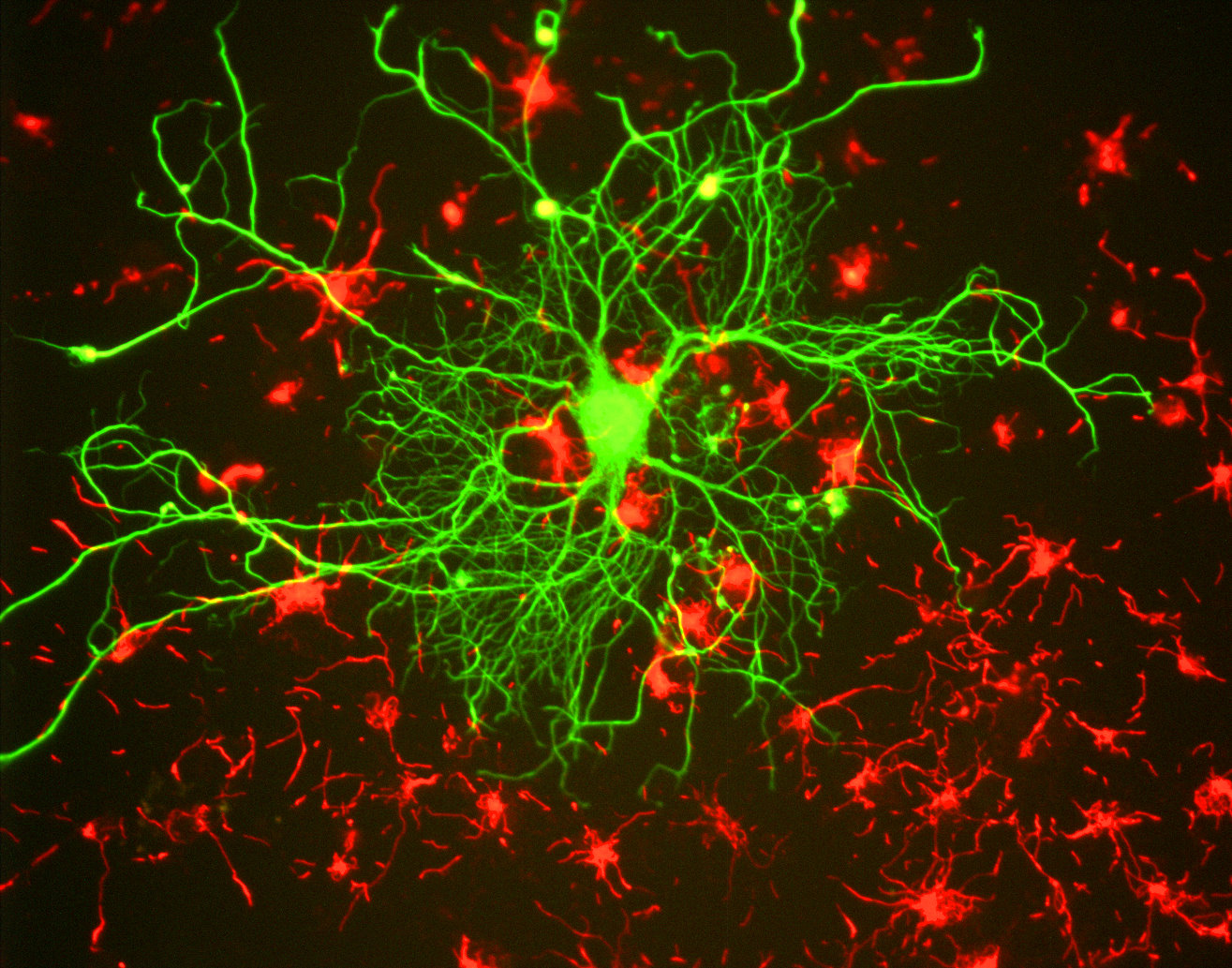
Another question I received whose content I was able to include in my paper concerned the brain's pleasure center. In class, I showed a video (see earlier post) that described food's activation of the brain's pleasure center. Someone asked if there was a way to simply turn the pleasure center off. To answer this question, I can say: sort of. Here is a picture of brain cell, or neuron connecting to a bunch of other neurons (see right). Whether they are gustation chemical receptors in the taste buds or olfactory receptors in the nasal cribiform plate, these receptors begin a cascade. When neurotransmitters transmit impulses, the pathways travelled by the electrical signals are known as signal transduction pathways. All drugs that affect the brain act at one or various places in the brain's signal transduction pathways. This can include messing with neurotransmitters or receptors in depression, anxiety, insomnia, and numerous other disorders. I have found that pharmaceutical treatments have, in fact, been administered to affect the signal transduction pathway associated with overeating. Specifically, I came across a patent designed to block odorant molecules from ever triggering the pathway stimulated through our sense of smell. When calcium channels are blocked in these receptors, food moderation can be achieved. There are numerous other ways to affect the pathway, but I stuck with one that seemed most prominent and interesting to me.
Another question I had was regarding confusion during the aforementioned video. The video states that as one eats the chocolate milkshake, pleasure decreases. This phenomenon, as I have come to learn, is known as sensory-specific satiety. Essentially, it demonstrates the law of diminishing returns, in which each subsequent bite of the same thing yields less of a reward than something novel would, which leads people to eat less. This could prove fruitful in studying if following a food with monotonous diet caused people to feel less of the rewards from food. An adverse effect, however, may occur in which people's cravings for novel food stimuli increase and cause binge eating of new food if forced to eat the same food for long periods of time. I did not focus on this very much because little to know significant differences have been found between obese and not-obese people when it comes to sensory-specific satiety. The topic, though, is very interesting and has garnered quite a bit of attention, as evidenced by the Sensa fad. Basically, you pour Sensa, whose method of action I have yet to really explore, on food, and it makes you feel full. Although this did not make its way into my paper, I would love to look into this and discuss it in my next blog post!
Those were the primary new additions to my paper that had to do with class questions. In my next blog post, I would love to tell you all (however many of you there are still reading) about the ideas of "framing" campaign ads and how they may help in public health campaigns.